Clayton Homes ranked No. 323 on the list of large employers, and Dollywood ranked No.138 on the mid-size list.
But it was Brunswick, which manufactures Sea Ray boats, that ranked the highest from East Tennessee: No. 10 in the large category. The Sea Ray Boats division is headquartered in Knoxville.
More on the list. But how was it made?
Forbes compiled the list in partnership with research firm Statista, surveying 50,000 Americans working at businesses with more than 1,000 employees. Participants rated their willingness to recommend their employers to family and friends.
The mid-size list includes 500 businesses with between 1,000 and 5,000 U.S. employees. The large list ranks 500 businesses with more than 5,000 U.S. employees.
Several other businesses headquartered in East Tennessee were recognized.
Tennessee Valley Authority ranked No. 129 on the large employers list. DENSO, which operates its largest U.S. manufacturing facility in Maryville, ranked No. 317 on the mid-size list.
Those with several East TN employees
The lists also include businesses that have a significant employee base in East Tennessee. These companies all employ an estimated 200 or more people in the Knoxville area, according to the Knoxville Chamber.
The large list includes:
ADT Security Systems
AT&T
Accenture
Bass Pro Shops
Best Buy
Bloomin’ Brands
Chick-fil-A
Coca-Cola
Comcast
Cracker Barrel
Domino’s
FedEx
Gap
Hilton
Home Depot
Intercontinental Hotels
Lowe’s
Marriott International
Papa John’s
PepsiCo.
Publix
Red Lobster
Siemens
Starbucks
State of Tennessee
Subway
Target
Texas Roadhouse
The Cheesecake Factory
Travelers
U.S. Bank
U.S. Cellular
U.S. Department of Energy
U.S. Postal Service
UPS
Verizon Communications
Wendy’s
Wyndham Destinations
YMCA
The mid-size list also includes Choice Hotels International and Melaleuca.
Business reporter Brenna McDermott can be reached at [email protected]. Follow along with her work on Twitter @_BrennaMcD.
Great assessment in Bloomberg LP on manufacturing’s skills gap. The Manufacturing Institute study in 2018 showed that manufacturing will have 2.4 million unfilled jobs by 2028 due to the lack of skilled workers.
The pandemic has blighted the career prospects of millions of Americans — but even after this crisis has passed, harnessing the country’s potential will be a formidable challenge for the new administration. To build a strong and lasting recovery, with a thriving, well-paid workforce, the U.S. will have to get a lot better at equipping people with the skills the economy needs.
The task starts with K-12 education, because that’s where inequality and lack of opportunity begin. If the schools fail, no later interventions can make up the difference. As the country lays this stronger foundation, a comprehensive workforce agenda should boost investments in career and technical education, help workers get training, and build partnerships between educational providers and employers. Immigration reform also has a role, because foreigners with talent and ambition can help revitalize the economy.
Professional young industrial factory woman employee working with machine parts putting, checking and testing industrial equipments cables in large Electric electronics wire and cable manufacturing plant factory warehouse
Area Development published the results of its 35th annual corporate survey outlining the effects of the global pandemic as reflected in executives’ site and facility plans.
As expected, the COVID-19 pandemic has affected the corporate readers’ location plans and priorities as they increased their resiliency efforts.
Nearly half (45 percent) of those responding to the survey are with manufacturing firms and 60 percent are the owners/presidents/CEOs, with the same percentage responsible for their companies’ final location decisions.
Brandon Bruce is one of those individuals who is full of ideas and, when he sees a need or gap, he’s generally ready with a solution.
Two of his latest initiatives are a new website named StartupTN and a related event – “StartupTN Demo Day.” In many respects, the website is an outgrowth of the Startup Knox website that Bruce and John Bruck launched about nine months ago.
“The organizing principle is regional,” Bruce explains. “That’s the way people look at our state.”
As such, StartupTN spotlights seven ecosystems from the Appalachian Highlands area (Northeast Tennessee) to Knoxville, Chattanooga, Cookeville, Nashville, Jackson and Memphis. There’s also a page for the entire Volunteer State.
Good article by Site Selection Group about how minimum wage increases often have a trickle-up effect. Learn how these increases are areas affecting wage escalation for warehouse workers.
Six major utilities announced a plan to ensure that electric vehicle drivers have access to a seamless network of charging stations connecting major highway systems from the Atlantic Coast, through the Midwest and South, and into the Gulf and Central Plains regions.
The Electric Highway Coalition – made up of American Electric Power, Dominion Energy, Duke Energy, Entergy Corp., Southern Co., and the Tennessee Valley Authority – announced a plan to enable EV drivers seamless travel across major regions of the country through a network of DC fast chargers for EVs. The companies are each taking steps to provide EV charging solutions within their service territories. This represents an unprecedented effort to offer convenient EV charging options across different company territories and allow EV travel without interruption.
The Edison Electric Institute estimates 18 million EVs will be on U.S. roads by 2030. While many drivers recognize the benefits of driving an EV, such as the ease of low-cost home charging, some are concerned with the availability of charging stations during long road trips. With efforts like the Electric Highway Coalition, electric companies are demonstrating to customers that EVs are a smart choice for driving around town as well as traveling long distances.
This effort will provide drivers with effective, efficient, and convenient charging options that enable long distance EV travel. Sites along major highway routes with easy highway access and amenities for travelers are being considered as coalition members work to determine final charging station locations. Charging stations will provide DC fast chargers that are capable of getting drivers back on the road in approximately 20-30 minutes.
“TVA and the local power companies we serve are focused on being innovative transportation leaders, and we’re pleased to collaborate with neighboring utilities such as American Electric Power, Dominion Energy, Duke Energy, Entergy Corp. and Southern Company on this initiative,” said Jeff Lyash, TVA President and CEO. “Together, we can power the electric road trip of tomorrow by ensuring seamless travel across a large region of the U.S. This is one of many strategic partnerships that TVA is building to increase the number of electric vehicles to well over 200,000 in the Tennessee Valley by 2028.”
Lyash believes that electrifying transportation can spur the same innovative transformation that electrifying the Tennessee Valley did back when TVA was founded. He said, “EV adoption will spur jobs and economic investment in the region, keep refueling dollars in the local economy, reduce the region’s largest source of carbon emissions, and save drivers and businesses money.”
TVA is leading the charge to increase EV adoption in its seven-state service area with the recently announced EV Initiative, which is based on building partnerships with LPCs, state agencies and other organizations. TVA is making investments and coordinating partner funding that could bring up to $40 million in programs to support EV adoption in the next five years. This initiative is a multi-year plan to accelerate the electrification of transportation through programs to reduce or eliminate the market barriers that currently prevent more people from choosing EVs. By addressing the barriers to EV adoption, the anticipated outcome is:
Well over 200,000 EVs on Valley roadways by 2028.
$120 million reinvested in the local economy per year from electric refueling.
$200 million in consumer fuel savings per year.
Almost 1 million metric tons of CO2 saved per year (or the equivalent of the carbon sequestered by 1 million acres of U.S. forests in one year).
This announcement comes on the heels of the recently announced partnership between TVA and the Tennessee Department of Environment and Conservation to develop and fund a fast charging network across the interstates and major highways of Tennessee. TVA plans to work with state agencies in other states to develop a fast charging network across the Tennessee Valley.
“Tennessee is on the forefront of the electric vehicle revolution thanks to its robust automotive manufacturing sector, supply chain capabilities, its highly trained workforce and its commitment to developing a reliable, fast-charging network,” said TDEC Commissioner David Salyers. “TVA’s participation in this coalition is a critical step in ensuring Tennessee’s fast charging network connects regionally and nationally, providing efficient transportation for future travelers while improving air quality in our state.”
The Electric Highway Coalition welcomes interested utilities to join as it seeks to extend the reach of network. Additionally, it supports, and looks forward to working with, other regional utility transportation corridor electrification initiatives.
The Tennessee Valley Authority is a corporate agency of the United States that provides electricity for business customers and local power companies serving nearly 10 million people in parts of seven southeastern states. TVA receives no taxpayer funding, deriving virtually all of its revenues from sales of electricity. In addition to operating and investing its revenues in its electric system, TVA provides flood control, navigation and land management for the Tennessee River system and assists local power companies, and state and local governments, with economic development and job creation.
Announcing a rare consolidation of major trade associations, Tennessee Chamber of Commerce & Industry President & CEO Bradley Jackson announced a comprehensive strategic partnership with the Tennessee Automotive Manufacturers Association (TAMA) aimed to significantly increase and enhance services for automotive manufacturing across the state. The effort will leverage the statewide presence, strength, and association management experience of the Tennessee Chamber to enhance the mission of TAMA primarily for educational events, networking, and member communication and services.
According to the Brookings Institute, Tennessee ranks as the #1 state for automotive manufacturing strength, employing over 123,000 Tennesseans and totaling over $4.8 billion in automotive exports in 2019. In recent years, Volkswagen, Nissan and GM have made billion dollar announcements to build electric vehicles and expand production of cells and battery packs in Tennessee, with other supply chain manufacturers announcing moves to the Volunteer state. Thanks to a partnership between the Tennessee Valley Authority and the Tennessee Department of Environment and Conservation, Tennessee drivers will benefit from a statewide EV charging network with the capacity to support 200,000 EVs on Tennessee roads by 2028.
The extensive agreement, negotiated over a year, will establish Board of Director appointments to both TAMA and the Tennessee Chamber as well as an operational partnership framework.
Tennessee Chamber President & CEO Bradley Jackson noted, “We thank TAMA for this tremendous partnership and opportunity to enhance automotive manufacturing here in Tennessee. Automotive manufacturing has become a cornerstone of Tennessee’s economy and is absolutely vital to our economic growth and success as a state.”
This new structure will allow TAMA to continue as a non-profit association while utilizing the significant infrastructure of the Tennessee Chamber to enhance and grow their operations.
TAMA President Dan Davidson noted, “This partnership will allow TAMA to enhance and expand our work and services to advocate for automotive manufacturing in Tennessee building on the great work we started in 1987. We have maintained a great relationship with the Tennessee Chamber as our State Manufacturing Association and believe partnering with such a significant organization will help us both to strengthen automotive manufacturing in the Volunteer State.”
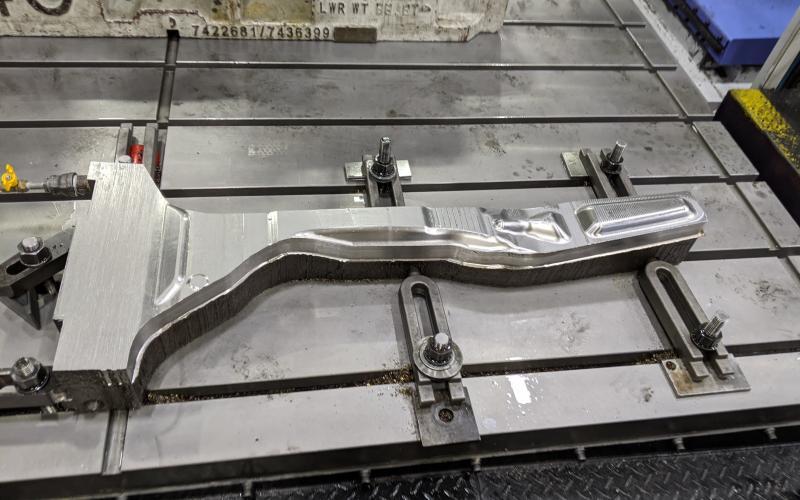
A team of Oak Ridge National Laboratory researchers demonstrated that an additively manufactured hot stamping die – a tool used to create car body components – cooled faster than those produced by conventional manufacturing methods, which could lead to reduced manufacturing costs and production time.
In collaboration with industry partners Lincoln Electric and DTS, they used a gas metal arc welding-based additive technology to print the die for a B-pillar or vertical roof support structure for a sport utility vehicle. The production method allowed for the entire body of the die to be created as one monolithic part.
“With conventional methods, the dies are manufactured by drilling cooling ports in one-foot-long blocks of steel, then assembling, machining the blocks and sealing, and they take 20 days to produce,” ORNL’s Andrzej Nycz said. “We machined and tested the additively manufactured die in eight days and showed more uniform temperature distribution and 20% improvement in the cooling rate.”
ORNL researchers used gas metal arc welding additive technology to print the die for a B-pillar or vertical roof support structure for a sport utility vehicle, demonstrating a 20% improvement in the cooling rate. Credit: ORNL, U.S. Dept. of Energy
In this Area Development article, redefining the workforce in a post-pandemic world will likely be driven by the ideals of our largest generation — millennials.
Eventually this pandemic will end, a vaccine will be readily available, and we will attempt to return back to our “normal” lives. But what does this next “new normal” look like? Can our next “normal” be an even “better normal”?
In this Area Development article it explores the topic of sustaining industrial labor needs during and after the pandemic.
Finding and retaining a skilled workforce continues to be a critical need, and those unemployed during the pandemic may need training and help with other issues to step into those open roles.















Recent Comments